
sast
Find, prioritize, and remediate code vulnerabilities
Invicti unifies SAST with DAST, IAST, SCA, and API Security so you can catch vulnerabilities in code early, correlate compatible findings with runtime evidence, and route fixes directly to the right developers.
5000+ Top Organizations Trust Invicti







The problem with legacy SAST
Every application starts with code, and flaws there can put everything at risk. But on its own, SAST can’t separate theoretical flaws from real risks. Without DAST correlation and broader context, vulnerabilities remain abstract issues instead of turning into actionable fixes tied to their source.

Noisy and out of context
Legacy SAST floods teams with findings but can’t separate theoretical flaws from real, exploitable risks. Without runtime correlation, findings are noisy.

Not built for developers
Faced with endless security alerts without clarity or remediation guidance, developers often feel overwhelmed and start ignoring SAST noise.

Isolated and clunky
Legacy SAST runs disconnected from DAST, SCA, and other security tools in CI/CD pipelines. Without correlation across tools, teams can’t prioritize effectively or trace runtime risks back to their source.
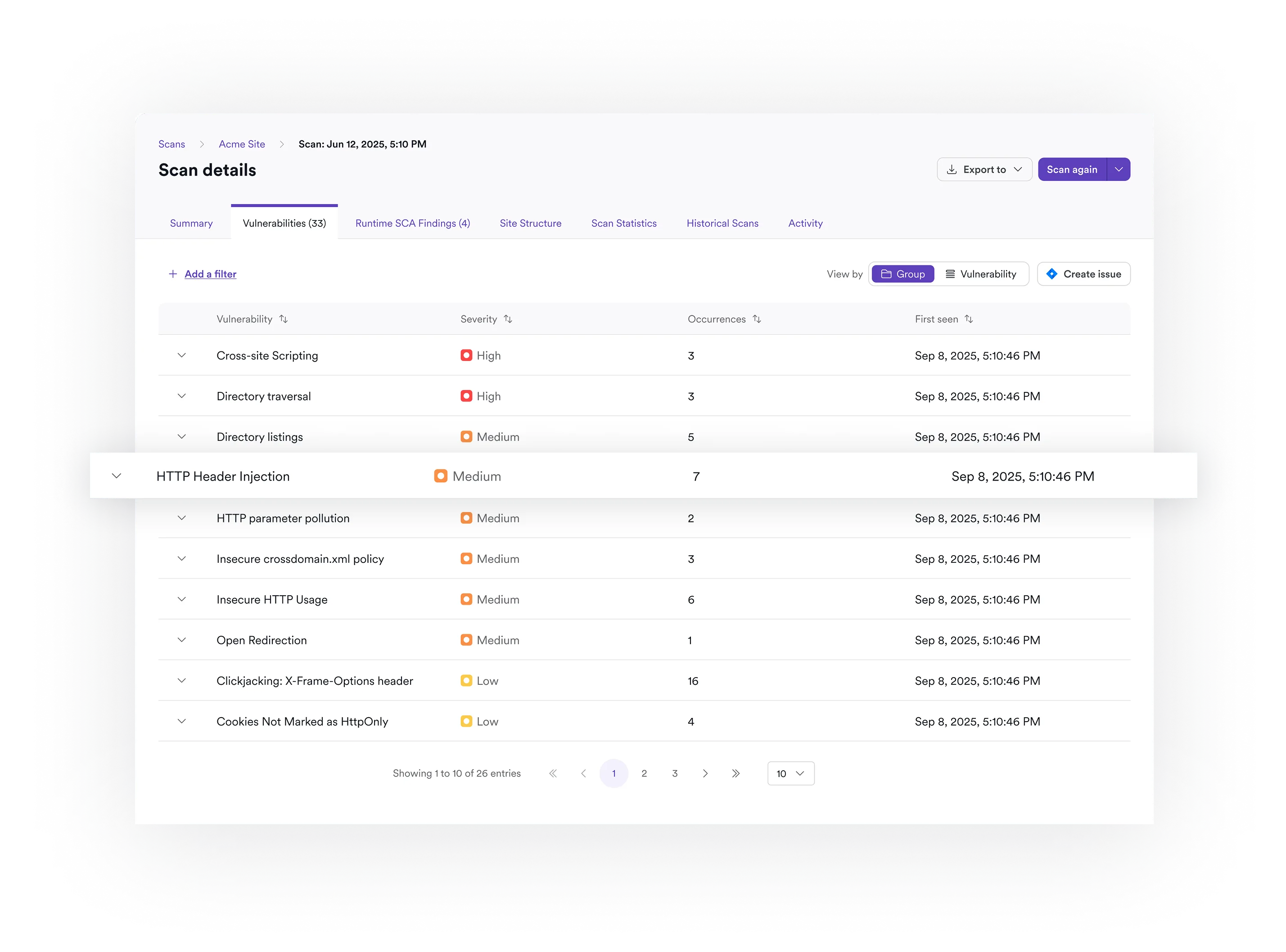
proof-based scanning
SAST without the noise
developer-centric
An AppSec tool devs actually want

Correlation and orchestration
No more tossing it over the fence

What customers say

“For more websites, we now don’t need to go externally for security testing. We can fire up Invicti, run the tests as often as we like, view the scan results, and mitigate to our hearts’ content. As a result, the budget we were spending every year on penetration testing decreased by approximately 60% almost immediately and went down even more the following year, to about 20% of our initial spending.”
– Brian Brackenborough | CISO, Channel 4

“Invicti detected web vulnerabilities that other solutions did not. It is easy to use and set up...”
- Henk-Jan Angerman | Founder, SECWATCH

“I had the opportunity to compare expertise reports with Invicti ones. Invicti was better, finding more breaches.”
- Andy Gambles | Senior Analyst, OECD

“Invicti is the best Web Application Security Scanner in terms of price-benefit balance. It is a very stable software, faster than the previous tool we were using and it is relatively free of false positives, which is exactly what we were looking for.”
- Harald Nandke | Principal Consultant, Unify (now Mitel)
Frequently asked SAST questions
Does Invicti offer SAST as a standalone tool?
Invicti provides built-in static application security testing (SAST) as part of the Invicti AppSec Platform. SAST works alongside DAST, SCA, API Security, and other capabilities to connect code-level findings with wider application risk. Where compatible SAST and DAST findings can be correlated, runtime evidence can help teams prioritize vulnerabilities and trace them back to the relevant code.
How does Invicti’s SAST work with SCA?
Invicti brings SAST and software composition analysis (SCA) findings into the same AppSec platform. SAST identifies vulnerabilities in application code, while SCA identifies risks in open-source and third-party components. Findings can be normalized, deduplicated, prioritized, and managed through common workflows alongside DAST and other application security findings.
How does Invicti’s SAST integrate with developer workflows?
Invicti integrates application security findings with developer and collaboration tools such as Jira, GitHub, GitLab, Azure Boards, Slack, and Microsoft Teams. Workflow automation can route vulnerabilities to the appropriate teams, enforce policies such as build thresholds, and keep issue status synchronized as developers remediate findings.
Does Invicti provide remediation support for developers?
Yes. Invicti provides AI-guided, code-level remediation suggestions to help developers understand and fix vulnerabilities. Teams can also use remediation knowledge and developer training integrations to address recurring vulnerability types and improve secure coding practices.
How does Invicti’s SAST reduce false positives?
Invicti SAST uses techniques including taint analysis, rule exclusions, and sanitizer allowlists to reduce noise during static analysis. Invicti can also correlate compatible SAST and DAST findings, connecting code-level vulnerabilities with evidence from the running application. This DAST-to-SAST correlation helps teams distinguish theoretical code issues from vulnerabilities that can be exercised at runtime, while also tracing runtime findings back to the relevant source code.
Does Invicti support open-source SAST tools?
Yes. Invicti provides built-in SAST and can also integrate security results from other tools. Open-source scanners can be orchestrated through the Invicti CLI, allowing teams to incorporate existing tools into centralized AppSec workflows.
How does Invicti help prioritize SAST results?
Invicti prioritizes SAST findings using context from across the AppSec platform. Where compatible SAST and DAST findings can be correlated, runtime evidence helps identify code vulnerabilities that can be exercised in the running application. Invicti can combine this evidence with other risk signals, including threat intelligence and application context, to help teams focus remediation on the issues that matter most.
How does Invicti’s SAST fit into an ASPM strategy?
Invicti ASPM provides an operational control layer for findings from SAST, DAST, SCA, container security, and other application security tools. It consolidates and normalizes findings, correlates and deduplicates related issues, applies risk-based prioritization and policy, routes vulnerabilities into remediation workflows, and tracks security posture and remediation performance over time.



Trace risk to the source
Correlate SAST with runtime proof to cut false positives and empower developers.
